Humishka Zope

I’m a graduating MS/BS student in Computer Science & AI at Stanford University. At Stanford, I did research in the Stanford NLP Group (under Dan Jurafsky & Diyi Yang). My prior work has focussed on large language model alignment and evaluation, with a broader interest in how AI systems reason, collaborate, and interact with people.
This past summer, I was a Research Intern at Microsoft Research, where I worked on improving LLM reasoning capabilities through post-training and test-time scaling with domain expertise. I also co-led Future of Work with AI Agents at Stanford, developing a novel framework to evaluate human–AI collaboration potential and quantify misalignment between human needs and AI capabilities across occupational tasks. This work has been featured in Forbes, Stanford HAI, and Yahoo Finance.
I’ve also spent time at Joby Aviation and Rippling, where I built transformer-based models leading to the company’s first AI product launch featured in Bloomberg.
Updates
- (Jan, 2026) Our work on synthetic data generation for LLM Safety was presented at Amazon Science Trustworthy AI Symposium in NYC!
- (Sept, 2025) Had a great summer at Microsoft Research as a Research Intern, working on post-training LLMs for optimization modeling!
- (June, 2025) Co-presented at Stanford NLP Group on Future of Work with AI Agents.
- (March, 2024) Honored to co-host the annual Faculty Dinner for Stanford Women in Computer Science!
Projects
*: Equal Contribution

OptiMind: Teaching LLMs to Think Like Optimization Experts
Zeyi Chen*, Xinzhi Zhang*, Humishka Zope*, Hugo Barbalho, Konstantina Mellou, Marco Molinaro, Janardhan Kulkarni, Ishai Menache, Sirui Li*
NeurIPS 2026 · September 2025
A self-improving LLM framework that enhances optimization reasoning through post-training and test-time scaling with domain expertise, achieving state-of-the-art performance in optimization modeling.
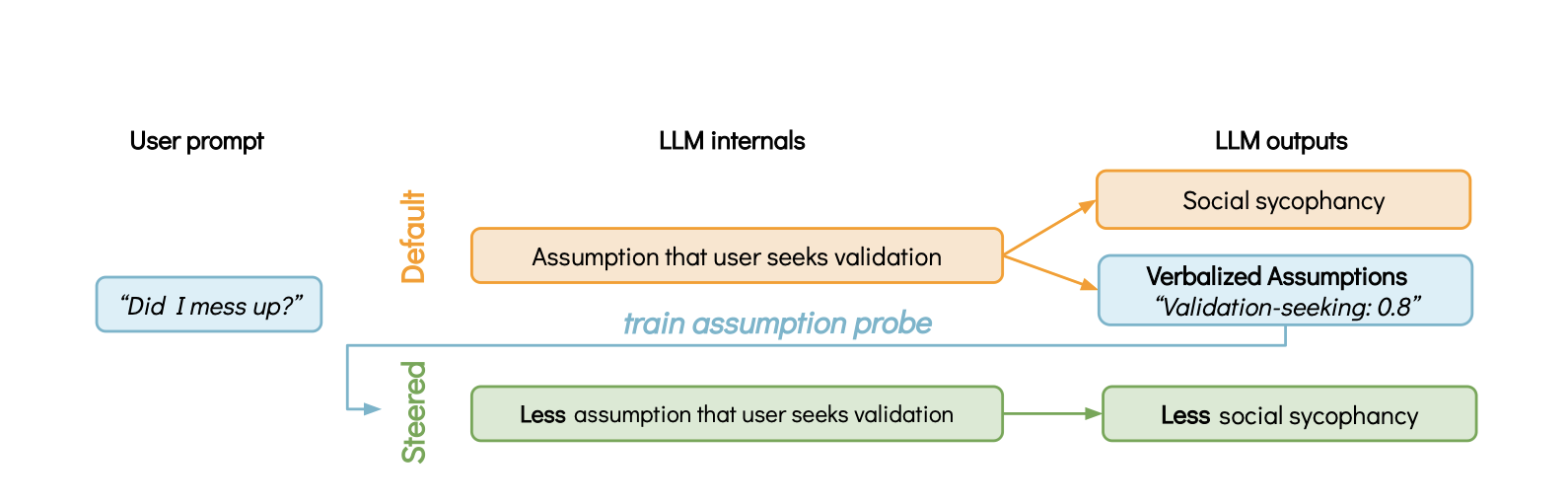
Verbalizing LLMs' Assumptions to Explain and Control Sycophancy
Myra Cheng, Isabel Sieh, Humishka Zope, ..., Dan Jurafsky, Diyi Yang
COLM 2026 · April 2026
Demonstrated that LLMs' verbalized assumptions about users are causally linked to sycophantic behavior. Introduced assumption probing methods using linear probes over internal model representations to interpret and steer social sycophancy.

Future of Work with AI Agents: Auditing Automation and Augmentation Potential across the U.S. Workforce
Yijia Shao*, Humishka Zope*, Yucheng Jiang, Jiaxin Pei, David Nguyen, Erik Brynjolfsson, Diyi Yang
Preprint (in submission) · Website · HuggingFace (~300+ monthly downloads) · June 2025
Developed a framework to measure human–AI collaboration potential and quantify misalignment between human needs and AI capabilities across occupational tasks. Built the WORKBank database to map desire–capability gaps, define the Human Agency Scale, and identify trends in demand for core human skills.
Featured in Forbes, Stanford HAI, Yahoo Finance.

Talent Signal: AI-Based Performance Management System
Developed at Rippling as a Machine Learning Engineering Intern.
Launched publicly as a product in 2024 · Blog Post · Bloomberg Coverage
An AI-based performance management system leveraging transformer-based classification models to assess employee performance and support performance review workflows.